Friday, June 29, 2012

Quick and dirty

Canoe orienteering protip:  stay in the boat

I've got a puzzle hunt coming up next weekend (sign up, folks!), and Potlatch this weekend, so my vast audience will have to be satisfied this week with a quick and dirty post.  Plus I'm exhausted from winning the Issaquah Street Scramble and DNF'ing the BEAST race at Union Bay (who thought getting out of their canoe would be a good idea during canoe orienteering?  This guy.)

The Past:  See what you've been missing


The Present:  If you lived here, you'd be home by now


I only quote the finest films

The Future: That is where you and I are going to spend the rest of our lives  

  • Long O - June 30, Salmon La Sac.  The mountains will keep the rain away, right?  Right?
  • ZLOGCAT - June 30, Cal Anderson Park.  Alleycat race.
  • Gorilla Challenge - June 30.  Amazing-Race + gorilla suits
  • 4th of July Cheshiahud Challenge - July 4.  Make your way around Green Lake, answer trivia questions for a chance to win Gold Bumbershoot passes.  Free.
  • First Thursday Adventure Run - July 5, Green Lake.
  • CitySolve Urban Race - July 7.  Another Amazing-Race
  • TRIOBA 24 Hour Adventure Race - July 7, Cougar, WA.  "There will be 15-25 miles of flat water paddling, 50-75 miles of biking, and 20-30 miles of trekking and trail running."  Be prepared, or just stay at home and rest up for...
  • Summer Puzzle Hunt 2012 - July 8, 1pm.  Put on by yours truly.
  • Road to the NACCC - July 14.  Alleycat (to fundraise for next year's North American Cycle Courier Championships), followed by a concert.
  • Evening Orienteering - Wednesday, July 18, Big Finn Hill Park, Kirkland.  With a big barbecue afterwards.
  • Pirate Treasure Hunt - Friday, July 20, 6pm.  Meadowbrook Community Center.  Family event, I imagine.
  • Amazing Kitchen Race - July 21, 11am.  Scavenger Hunt + cooking competition.  Paging Menu Hunters Anonymous.
  • Urban Bike Adventure - July 22.  Looks like a bike version of the Amazing Race.  Solve puzzles, bike to checkpoints, cash and other prizes.  I'd totally enter this except I have a prior commitment.
  • Tour de Watertower - July 22.  A punishing race to all of Seattle's high hills ('cause that's where the watertowers are, baby).  Since the towers and the starting/ending points are widely known, this race favors speed and endurance over route planning.
  • Choose Your Own Adventure - July 22, UW.   Orienteering on campus, with a get-together at the Big Time Brewery afterwards (in the early afternoon, which means the Big Time is all-ages).
  • Seattle Night and Day Challenge, July 28-29, show up around 2:30 at Road Runner Sports in Green Lake.  Basically a gigantic Street Scramble that covers most of Seattle and starts at 4pm, with options for 90 minutes, 3 hours, 7 hours, and 16 hours.  16 hours gets you a real 'night and day' experience.  I prefer the 7 hour option, which still gets you some night, but with less of the hangover after you pull an all-nighter.  If you clear the course (I almost did it once; forgot the Locks closed at 9pm, dammit), you'll go around 70-80 miles.
Geocache puzzle of the week:  Puzzler's Puzzle.  One puzzle too easy for you?  How about 31?  Solve (or at least partly solve) 30 puzzles so you can solve the underlying meta-puzzle.  This one took me about 15 days.

Friday, June 22, 2012

Divvying up the Spoils

Look at this blanket, filled with glamorous prizes

Everyone wants to have this problem:  you've just won a contest, and now you have to divide the prizes among your teammates.  If you won it all by yourself, no problem, but that's usually not the case.  And don't think you can put this off until you've got the prizes in hand.  In one contest I participated in in Germany, teams split up after arguing about how to split the prize before they were even close to finding it.

So it's best to have at least the outline of a plan beforehand.  My suggestions:

Say you're going to split it all evenly (or as evenly as possible) and work out the details later.

If you do manage to win a big enough prize (or a set of prizes) see if there's a way to use part of it to throw a party for everyone who participated and helped.  That way, even people who performed a minor role, such as lending you a piece of equipment or watching your kids while you went out searching late at night, can get a reward.

If the prizes are easy to divide, do so.  But if they're a diverse lot (like the collection of things above that I won from the Emerald City Search), don't bother trying to make things come out evenly in value.  Instead, ask everyone what they want most and try to get everyone at least one of the things on their list (it's better to get people to declare their wish list in public, so that if someone doesn't get their first choice, they know why).  If there are conflicts, order people at random rather than trying to figure out who 'deserves' it more. After everyone's got something they want, people take turns picking prizes from the pool like an NFL draft, until everything's picked or no one wants anything that's left.  If you manage to do this quickly, you can take the leftovers to the party and invite your guests to just take what they want.  Or you can donate the remainders to a charitable auction, or use them as prizes at your own puzzle hunt.

Charitable Canlis Card

One of these cards is not like the other

One of the Canlis cards I won back in 2010 poses an entirely different problem.  The card is good for a dinner for two people, annually, but I cannot use it myself.  Instead, I must give it away to a person who has displayed philanthropy (in some way) in the Seattle area.

There were 11 of us who participated in the final hunt that won the cards, and my first impulse was to rotate the power to choose the card's recipient among the members of my team.  But my wife suggested a better idea would be for us to do it together as a team.  So this week, for the second time, as many of the 11 that could got together at our house to have a drink, nosh, and discuss who should get the 'charitable Canlis card'.

Only 7 of the 11 could make it this year.  One person was out of town, but he wanted to participate, so we tried various technological solutions, eventually settling on a Google+ 'hangout' (which also allowed us to simultaneously see and edit a Google doc listing the people we were considering).  After we got the hangout set up, we decided we might as well invite the two members who had moved away last year as well.  One of them ended up joining us, making 9 in all.

I had decided we should pick the recipient by 'consensus', but there are a number of ways to do so.  I liked the Apache Project's consensus method the best, although I had to modify it for the case where we had to choose one of many possibilities.  Under the Apache model every voting member has 3 possible votes:  thumbs up, thumbs down, or no vote (abstain).  Thumbs up and no vote can be made without explanation (although you're welcome to explain if you like), but you can't vote thumbs down without a good explanation.  In most cases, a single thumbs down means a veto of whatever is being voted on, which works well in a consensus situation, since presumably anyone who gets a thumbs down will not be agreed on by everyone.  Conversely, everyone who doesn't get a thumbs down is at least acceptable to all the voters, so our only question was which of the people who got no negative votes is the 'best' candidate.

[Incidentally, most of the negative votes are by the person who suggested the candidate in the first place.  "I know I suggested X, but I'm not sure about them, so I'll come back next year and see if I can find someone else who does the same thing better."]

Last year, the answer was pretty easy, as one candidate had thumbs up from everyone, and no other candidate was even close.  This year, however, we had 3 candidates with 8 or 9 thumbs up, one with 5, and a few with 2 or 3.  So I made it up as I went along.  We dropped a few, had another round of voting, which narrowed it down to 2 finalists, and eventually selected Bonnie Miller, by the oh-so-definitive score of 5 votes to 4 (good thing we found person #9).  Bonnie has volunteered her time for years organizing and working on environmental projects in Seattle, most notably at Magnuson Park and with the Friends of the Burke Gilman Trail.


News and Events

The 9-5 Scavenger Hunt was magical


Ongoing


Upcoming 

  • Girls of Summer Alleycat, pt. 2 - June 23, I-5 Colonnade Park. Over $3000 in prizes.  Holy smoke.
  • Urban Dare - June 23. Amazing-Race style event. 
  • Issaquah Street Scramble - June 24. I will be there.
  • BEAST race #3 - June 28, UW Waterfront Activities Center.  I will also be here, as I love canoe orienteering.
  • Long O - June 30, Salmon La Sac.  Great spot to camp and orienteer.
  • ZLOGCAT - June 30, Cal Anderson Park.  Alleycat race, sponsored by a fixed gear bike blog.  Costs more than most alleycats ($15), but you get a T-shirt, and I'm guessing the prizes are better.
  • Gorilla Challenge - June 30.  Amazing-Race style event.  Bonus:  people running around in gorilla suits!
  • First Thursday Adventure Run - July 5, Green Lake.
  • CitySolve Urban Race - July 7.  Another Amazing-Race-esque race.
  • TRIOBA 24 Hour Adventure Race - July 7, Cougar, WA.  "There will be 15-25 miles of flat water paddling, 50-75 miles of biking, and 20-30 miles of trekking and trail running."  Be prepared, or just stay at home and rest up for...
  • Summer Puzzle Hunt 2012 - July 8, 1pm.  Put on by yours truly.
  • Evening Orienteering - Wednesday, July 18, Big Finn Hill Park, Kirkland.  With a big barbecue afterwards.
  • Pirate Treasure Hunt - Friday, July 20, 6pm.  Meadowbrook Community Center.  "Put on your eye patch and bandana and follow the clues in search for hidden treasure with the help from REAL pirates!  A backyard BBQ will follow.  Fun for the whole family."  Sounds like the Seafair pirates just might attend.
  • Urban Bike Adventure - July 22.  Looks like a bike version of the Amazing Race.  Solve puzzles, bike to checkpoints, cash and other prizes.  I'd totally enter this except I have a prior commitment.
  • Tour de Watertower - July 22.  A punishing race to all of Seattle's high hills ('cause that's where the watertowers are, baby).  Since the towers and the starting/ending points are widely known, this race favors speed and endurance over route planning.
  • Choose Your Own Adventure - July 22, UW.   Orienteering on campus, with a get-together at the Big Time Brewery afterwards (in the early afternoon, which means the Big Time is all-ages).
Here's a write-up on last weekend 9-5 all-night bicycle scavenger hunt, by a participant:  9 to 5 on my 925

Geocaching puzzle of the week:  Buta Sudoku  Sudoku with a twist.  I've solved the 4x4 version, but screwed up the 9x9 version twice.  I'll get you, egg!


Saturday, June 16, 2012

Canlis

Not looking a day over 52

Canlis is a fine dining restaurant in Seattle, just on the south side of the Aurora Bridge.  It's best known for excellent Northwest cuisine, impeccable service, a great view, and their Puzzle Hunt Contests.  As they say on Sesame Street, one of these things is not like the other.

Canlis is a family-owned restaurant, and it's the third generation of owners, Mark and Brian Canlis (grandsons of the founder), who have been driving the Puzzle Hunt Contests.  The great food, service, and view have been there since the beginning.  Or so I've been told; I had never been there until December 2010, when the restaurant was already almost 60 years old.  It's not coincidental that this corresponds to their first contest.

Contest #1 - Cheap Eats

Your key to cheaper fine dining


For the restaurant's 60th birthday, the Canlis brothers hid 50 facsimiles of the restaurant's 1950 menu around town, one at a time, usually one per day.  After hiding one, they would release a clue via Facebook or Twitter (for example, "Squash a beetle in your hand", referencing the Fremont Troll, who holds a VW bug in one of his hands).  If you found the menu, you could bring it into the restaurant for a dinner for two at the prices on the 1950s menu (so, for example, $6 for a lobster instead of $60).  In actuality, if you won you got to order off a 2010 version of the 1950 menu, as some dishes they weren't going to do, like 1950's extensive selection of pickled seafoods and shrimp cocktails (my son was actually disappointed about that).  Still, $5 steak and $6 lobster was quite a draw, and thousands of people tried to find the menus.

Some clues were harder than others, but in general they got harder as they went along.  Usually one of the brothers would be on hand to congratulate you when you found a menu.  Sometimes they would even give it to the first person who spotted them and asked for it, particularly if it had been some time since the clue had dropped and no other hunters were in sight.  The sole exception occurred late in the hunt, when they left one at the old Rainier Brewery overnight and tweeted the clue at around 4am.  Sometimes they would each have a menu and you had to find one of them, or they would give a clue that indicated two locations, such as the two ends of the Burke-Gilman Trail and one would be stationed at each spot.

How Church got from Here to There
As a rule, the clues were structured like poems (see below), although they also used simple ciphers and photos.  The clues used a diverse number of tricks about a diverse group of places, although they generally referenced Seattle history, especially Seattle restaurant history.  Most of the answers were Googleable, at least in hindsight.  For example:
Never fear, Church is here, but how did she get from here to there? 
Clearly Church is or was a woman.  But Googling for 'Seattle Church' gets you nowhere.  Wikipedia comes to the rescue, as they have pages of famous people who have a particular surname, which leads you to Ellen Church, the first flight attendant in history, whose plane is on display at the Museum of Flight.  This was the menu I found, which my wife and I used for a delicious and heavily discounted meal on our 14th anniversary.

But that wasn't all, as all the menu winners were invited to participate in a final hunt on New Year's Eve Day.  Everyone could have a team of up to three in a car, and as many as you could get helping at home.  You can read the whole story, but here's a summary:  I assembled a formidable team, and together we solved five clues and a final puzzle in Gasworks Park to find two buried gold Canlis cards, each good for 2 dinners for 2 every year.  One we get to keep; the other must be given away to a philanthropic person in Seattle.  It reminds me of being a character in a Jane Austen novel.  Mr. Darcy is worth 2000/year, Mr. Collins is worth 500/year, and I'm worth 2 fancy meals/year.

Contest #2: Pop-up

Spot the Morse Code (photo by Joshua Longbrake)


Early in 2011, the Canlis brothers started a slick online campaign to help their chef, Jason Franey, win an online poll.  They took a series of black-and-white photos of themselves in famous Seattle locations (The Space Needle, Safeco Field, Gasworks Park) wearing signs such as 'Vote for Jason'.  This was clever enough, but there was another contest hidden in the campaign:  each photo had had a letter or letters Photoshopped into it in Morse Code.  After finding 'w', 'w', 'w' and '.' in the first four photos, it wasn't hard to determine that it was a web address.  One enterprising couple paid for a reverse whois lookup and discovered the domain before it had even been set up.

By this point, I had decided it was best to enter these contests as a team (particularly since I was about to go out of Internet range for a Mt. Rainier vacation).  Eventually, our team found "www.qth", which was good enough to guess the correct web address:  www.qthseattle.com (QTH is a 'Q code' from ham radio, indicating "my position is").  This address was subsequently used in Contest #3, so it's no longer secret (and the content has changed).

On the website, there were originally instructions to send an e-mail for a reservation to a pop-up restaurant, where Franey and the rest of the Canlis staff could try something a little different for a couple of nights.  The members of our team, as well as the couple mentioned above were the only ones to get a reservation before the reservations were open up to the general public, and we all got a free meal for two.  I took my older son, who declared it the best meal he had ever had in his life.

Contest #3: Keys

Key #1 was here (Photo by Brian Canlis)
By now, people were beginning to catch on that the Canlis brothers liked putting on these contests, so there was quite a frenzy when they started another one in late September 2011, with a link to the mysterious image above and little other explanation.  Crucial to this contest was the fact that JennyLee Lieseke, who had hunted unsuccessfully for a menu but did manage to get a free meal at the Canlis pop-up, had set up a Facebook group, Menu Hunters Anonymous, back in 2010.  Soon after this contest started, JennyLee started promoting MHA on the Canlis Facebook page as the place to go to talk about the new contest.  This time, the Canlis brothers cryptically mentioned that "you can't do it alone", so everyone seemed eager to collaborate on a solution, and MHA's membership grew from a couple of dozen to over 500 by the end of the contest.

After the first few days, it became clear that each photo represented a sign located somewhere in Seattle, and the signs in the pictures all had a hidden key attached.  After a few days of finding one key a day, the brothers released more details:  there were 30 keys in all, and each represented a table at the restaurant for a special dinner on Sunday, October 30.  Crucially, though, the keys were all already out there.  This started somewhat of a frenzy, as people started looking for and finding keys without clues.  After a day or so, with all the keys mapped on one Google map it became clear that the key locations formed the outline of a shape, which made searching even easier, as the keys could only be on the lines of the shape.  By the 9th day of the contest, all the keys were found.

1 of a precious set of 30 (Photo by Justin Tittelfitz)

But what to do with the keys?  The shape they formed was a giant arrow, and the keys were safe deposit box keys, so even with incomplete information it seemed logical the key bearers should go to a bank at the tip of the arrow.  At the bank, the employees would take your key and let you open a special box which contained your official invitation (and told you how many people were at your table).  On October 30, everyone met for a nice dinner party with great food.  In a great community gesture, many of the people who made contributions to the solution but never found a key (such as the compiler of the map, and the first person who suggested the 'giant arrow theory') got invited by key winners who had room at their table.

Contest #4: ???

There's no reason to think that's the end of the Canlis contests.  On their 61st birthday in December 2011, the Canlis brothers with little warning hid a menu at St. Marks Cathedral on Capitol Hill and released another clue.  They indicated they'll probably continue to hide a menu every year.  But the smart money says there will be another big contest sooner or later.  With great food for free, or at least cheap, a lot of people will be eager to try to win it.  If you live in the Seattle area, like Canlis and Menu Hunters Anonymous on Facebook, and join us for the next hunt.

News and Events

Where you need to be to win a DeLorean from the author of Ready Player One


Geocaching puzzle of the week:  I've been working on the Puzzler's Puzzle, which has a number of good puzzles.  Here's one I solved after a fancy dinner (at Place Pigalle, not Canlis) this week:  An Odd Cache.

And there wasn't much of a puzzle to this one, but the Amazing Race analogies continue, and this story has a Seattle connection:  James E Rogers grad wins space trip.


Thursday, June 7, 2012

Two Beginnings and an Ending

Obligatory Back to the Future pic

This week saw the start of two hunts and the end of another.  At stake: some books, a dozen emerald-studded objects, and a 1981 DeLorean.

Find some books, Seattle Teens

As promised, on June 1, the Seattle Public Library released details on its Teen Summer Reading Book Scavenger Hunt.  Basically, they are using a pre-existing website called bookcrossing.com to track the roughly 1000 books they have 'hidden' around the city.  You're supposed to be a teen to participate, so if you find a book with this label on the front cover
and you are not a teen, just put it back.

If you are a member of my vast teenage audience, go ahead and take it home, read it and 'release' it by putting it somewhere other teens are likely to find it.  Then post a note on BookCrossing giving a hint where you left it.  Unfortunately, BookCrossing's user interface is rather clunky for prospective seekers.  To find the hints, choose 'Traveling' from the 'Select Filters' dropdown in the right column of SPL's BookCrossing page.  Then look for books that have 2 or more journalers and read the latest journal entry.  Looks like there's no 'search nearby' function, so you have to look at journal entries until you find one near you.  A lot of them appear to be left in a library (c'mon Seattle teen readers, mix it up a bit!), but some have been left in cafes or stores as well.  I keep thinking someone will put one in a ziploc bag and hide it under a bench, but I think that's because I've been doing too much geocaching lately.

One of the titles hidden is Ready Player One by Ernest Cline.  Which is a great segue to new contest #2...

It's a New Car!  (Actually, an old car)


June 5th was the release date of the softcover edition of Ready Player One, a novel where video games play a central role, written by a guy who apparently shared some of the same obsessions of my youth (Atari 2600 games, Ghostbusters, Galaga) but hasn't quite let them go.  To celebrate/drum up interest in the book, Ernie unveiled a contest that will be played out over the summer.  Basically, there is a secret message in all print editions of the book (hardcover and softcover, so the message has actually been out there for almost a year), which leads to a series of 3 video games.  Be the first to conquer all three games, and you win a 1981 DeLorean which Cline bought on eBay recently (not to be confused with the 1982 geeked-out DeLorean Cline has been driving around for a while).  The car is claimed to be worth $25,000 (seems legit).

Should you rush out and buy the book/give up in despair because you didn't hear about this a few days ago?  Nope.  While the first game is out there waiting to be played and solved, the second won't be released until July 1st, and the third until August 1st.  So you have time.  In fact, if you're on the West Coast, you might have an advantage, since presumably it will be an all-out race on August 1st, and the game will actually be released at 12:01am EDT August 1st, a somewhat inconvenient time for some, but a good time (9pm) to start an all-night game party out here.  Order your half-racks of Jolt Cola now.

I bought the book on June 5th, mostly because the reviews seemed good and I knew at least my tween would enjoy it.  The coded message isn't that hard to find.  It took me only a few minutes of browsing the book to figure out what it probably was, and a few more minutes after I bought it to actually decipher it.  As for the game itself, it's an Atari 2600 game that doesn't seem to hard to solve.  "But wait," you might be saying, "my parents threw my 2600 out when I left it in the closet to go to college!"  Alternatively:  "The Atari 2600 is older than I am, grandpa.  Why would I have bought such an antiquated gaming system?"  Silly you.  2600 emulators are a dime a dozen.  You can play the game online as a Flash game (the 2600 had a whopping 4K of ROM and 128 bytes of RAM; your iPod remote is probably more powerful), or download it and play it on a standalone emulator (I use Stella for the Mac).

The game itself is like a low-resolution version of Impossible Mission, where you run around dodging robots and finding puzzle pieces.  Well, there's a deadly flasher involved as well.  But still, a familiar format, and probably one you can figure out pretty easily.  Tangent #1:  I spent one week at college playing Impossible Mission on my friend's Commodore 64 in lieu of actually studying for finals.  Tangent #2:  I'm always reminded of the evil scientist's cry of "Stay awhile... stay forever" when I pass the "Bothell:  For a day, or a lifetime" sign on Bothell Way.

Ernie Cline's book tour for Ready Player One stops at Elliott Bay Book Company on June 20th at 7pm.  Go ask him about the Jungian symbolism in Adventure.

Time runs out on The Clock without a Face (sorry)

Got no human grace

And speaking of books, the armchair puzzle book, The Clock Without a Face, was apparently solved about a week ago when the 12th 'number' on the clock face was found in Washington.  Washington, California, that is.  I'm sorry I had not heard of this contest before (there was a story on NPR a couple of years ago, but I missed it):  the book looks gorgeous, the puzzles look interesting, and it was all published by McSweeney's, so:  quality!

The object was to find the 12 'emerald-studded' numbers that make up the clock face (the actual numbers do not appear to be particularly valuable, so the joy was mostly in the solving).  Most/all of the numbers were hidden at highway rest stops, so the puzzles boiled down to figuring out a state, a highway, and a mileage marker.  Except the authors decided after a period of time to dig up the unfound numbers and give different clues (i.e., another puzzle).  The last number was left at General Delivery at a post office in a small town in California.  On a hunch, the finder e-mailed the hotel in town to ask about the fictional 'Roy Dodge' (the detective in the story), the hotel owner said they'd never had such a guest but, strangely enough, she was also the postmaster and a package had been sitting in the post office since last fall waiting for Roy Dodge to pick it up.  The rest is armchair puzzle book history.

Ongoing and Upcoming

Totally photoshopped, dude (see Geocache puzzle of the week, below)

Geocache puzzle of the week:  Where's This?  See the surreal picture above (an alternate view of the image in the puzzle).  Be amazed at how Google image search makes it possible to even come close to figuring it out without ever leaving your couch.  (Thanks to Grace Hensley for pointing me to this one.)

Thursday, May 24, 2012

Street Scrambles (or, a few of my favorite things)

This map will be of dubious utility in Gig Harbor

This Saturday, May 26, is the perfect chance to try out a Street Scramble, since there is a free one in Gig Harbor (just across the Tacoma Narrows Bridge).  It's a beautiful spot, the weather is going to be great, you were going to get out of the city anyway, and did I mention it's free?

Street Scrambles are basically urban scavenger hunts:  you get a map with around 30 checkpoints circled, each of which has a number from 10-59.  Each checkpoint you visit is worth 10-50 points based on the number:  Numbers 10-19 are worth 10 point each, 20-29 are worth 20 each, etc.  The object is to get as many total points as you can within a time limit (at Gig Harbor, either 90 minutes or 3 hours) by visiting checkpoints.  You prove you visited a checkpoint by answering a simple multiple choice question.  For example:
Park sign
At what time does the park close?
a) 10pm  b) 11pm c) open 24 hours
You must travel under your own power, except kids can be pushed, carried, etc. by older folks (so, strollers are allowed).  There are numerous competition classes, based on how you get around and how old the people are on your team, so that families with strollers are not competing with adults on bikes.  The prizes are pretty minimal (top 5 in each class get a ribbon, winner in each class gets a pen, I believe).  But another good thing about going to Gig Harbor is they have a little festival set up at the starting line, so you can get balloons and other small prizes, there is usually a touch tank with tide pool creatures, and the last few years there has been some kind of rocket club booth where kids can build a stomp rocket and launch them into the sky.  Repeatedly.

My family and I have been doing Street Scrambles for years, including the first Street Scramble in 2004 in the University District, which we did with our older son, Omar, in a stroller and our younger son, Emmett, on my wife's back.  From there, we went to towing the kids in trailers, then on a Trail-a-Bike, then with Omar on his own bike.  These days Omar does 90 minutes by himself on foot while I usually tow Emmett on the Trail-A-Bike. We have a good time, see a lot of new and interesting spots, learn a bit of neighborhood geography, and get some exercise.  We're also good friends with the people who put these on, and I have been tapped the last few years to design the course for the Fremont Oktoberfest Street Scramble.

You should join us this Saturday in Gig Harbor, or at another Street Scramble in the future (like, say, Fremont, September 23).  Let me share some of my vast experience with you...

How to have fun

I designed the course, so of course they're having a good time

If all you want to do is have fun, you should be prepared for a 90 minute or 3 hour walk in the neighborhood (snacks, water, comfortable shoes), and not worry too much about route planning.  When you show up at the event site, you'll need to stand in line to register, sign a waiver, and get your answer sheet (unless you've pre-registered, in which case you need to stand in a shorter line to sign a waiver and get your answer sheet).  Once you have your sheet, you can look it over to get some idea of what the checkpoints are.  If you're in it for fun, see if any of the checkpoints sound particularly interesting.  Telephone pole?  Probably not.  Bowling ball sculpture?  Now we're getting somewhere.

I'd advise showing up a little more than an hour before start time (8:50am for a 10am start at Gig Harbor) to avoid long lines.  Gig Harbor's festival makes it easy to pass the time, and you'll be getting a map at 9:30 anyway, so you can spend the last half hour planning.  For extra enjoyment, use the restroom before everyone starts lining up at 9:45, or if you aren't being competitive, wait until after the start.

If you're having fun, you should mostly use the map to figure out what checkpoints look the most interesting to you.  Maybe you always wanted to go to a particular park, or you want to get a 50-point checkpoint (most of these will be far away, but there's usually one or two that are closer to the start).  You should have a rough idea of how far you can go in 90 minutes/3 hours, but be aware that, particularly with bikes, you can't go at top speed because you will have to spend time stopping, looking for the answer to the checkpoint, marking it down, and figuring out where to go next.  I do about 10mph average on my bicycle during a Street Scramble, less if I'm towing a kid, whereas I can usually do 12-15mph otherwise, even in the city with stoplights.  You won't notice as much of a dropoff if you're on foot, as you can usually do things like mark your answer as you're moving on to the next checkpoint when you're walking or jogging.  Once you have an idea where you're going, use a highlighter to mark a rough route on your map.  You could mark the exact roads to use, or just connect the dots between the checkpoints you think you'll visit.

When you're out on the course, you want to keep moving when you feel good, while remembering to stop for food, drink and rest occasionally.  You don't want to return late (there's a 10 point/minute penalty if you do), but you usually don't need to worry about time until the halfway point.  After this point, you should keep asking yourself:  can I get back to the start on time?  At the halfway point, the answer is almost always yes, since you could just retrace your previous route.  In fact, at the halfway point you can usually get back with plenty of time to spare, since your first half route was most likely a zigzag that was much longer than the direct route back.  Take a guess as to when you should next evaluate where you are (15 minutes later, after the next 3 checkpoints, etc.), and continue to do this until the end.  Also, be sure to re-evaluate if you take a wrong turn or spend too much time looking for a checkpoint.  If you keep checking in and start making your way back at a reasonable time, you should make it back from your hunt on time or close to it, having had a good adventure.

At each checkpoint, the answer should be very obvious; there are not supposed to be any trick questions.  If you can't find the object you're looking for, chances are you're in the wrong place, so double check that you are where you think you should be.  Checkpoints should be in the exact center of the checkpoint circles, so use that to your advantage:  if the circle looks like it's off to the right side of the street, that means the checkpoint is on the right side, not the left.

Two caveats:  First, the course designers sometimes make mistakes, or things change.  That bowling ball sculpture that was on the porch last week may have been moved to the backyard.  Second, the base maps used are USGS maps that may be 20 years old.  Course designers try to add features that would be useful (a new staircase, for example), but they don't update everything.  Buildings may have been added or torn down, so treat buildings on the map (depicted as black rectangles, usually) with particular suspicion.  If you're spending too much time at a checkpoint and can't find the answer, give up.  If you're sure you're in the right place, proper protocol is to mark through all the answers and write a short explanation in the margin (e.g., "no sculpture here").

Having fun with kids

Kids tend to have sharp eyes

Doing a Street Scramble with kids is a different matter.  If you're carrying or pushing them about, it's just like any other trip you might take.  But if your kids are under their own power, you will have to make sure they're fueled and motivated.  Kids often don't pace themselves well, and wear themselves out.  Or they forget to eat and drink, and melt down after a while.  When I do a Street Scramble (or other active event) with my kids, I make sure there's a break every half hour, and shamelessly bribe the kids with M&Ms.  Give them one after every checkpoint.  And one after you visit a high-value checkpoint.  And one every 50 or 100 points.  And, what the heck, double it if they went uphill to get it.

Also, be sure to remind your kids to use the restroom before you start.  When you're done, reward them with something good to eat and a trip to the playground.  The December Street Scramble in the Market, which visits many downtown holiday decorations, is a particularly good one to bring the kids to.  As is the one at Gig Harbor.  Stomp rockets!

Doing Street Scrambles well

These blue ribbons could be yours

If you crave one of those ribbons or pens, you need preparation and practice.  Practice is self-explanatory; like any athletic event, the more you do it, the more likely you do it well.  If you've been to the neighborhood before, whether as a resident or a visitor, you'll know your way around better, know any shortcuts there might be, and may even have been to a checkpoint or two before (Note:  if you already know the answer to a checkpoint, you're still supposed to visit it to get the points.  Street Scrambles are not trivia contests).

But let's suppose you've never been to the place before.  That's where preparation can pay off.  Look at a map of the area before you go.  You can usually pick out likely checkpoint spots just from Google Maps (parks, trails, schools, prominent works of art, ...).  If a likely spot seems difficult to get to, consider how you might get there:  e.g., how do you get through the light rail construction to get to the UW climbing wall?  If there are barriers that are hard to get around (light rail construction, I-5, bodies of water), familiarize yourself with the best ways to cross or go around them.  Note that access points like this are often specifically marked on the Street Scramble map (with red arrow/triangles), but not always, and it helps to know where they are in advance.

Finally, if there are any hills nearby (look at Google's terrain view, or the Topo view on gmap-pedometer.com if you don't know), I can guarantee there will be checkpoints near the top or (this frequently happens near the water) near the bottom.  Sometimes there's only one way up or down, but in an urban area, or where there's a long ridge (such as near Gig Harbor), there are usually numerous ways to climb it.  Figure out which ways are best for you:  do you like a steep hill for a couple of blocks, or a long, slow climb?  Again, topo maps can help you figure out the most gentle routes, but following a creek is usually a good bet if you want the gentle route.  You almost always only want to climb a hill once, so when you do, try to get all the checkpoints on the hill before you go back down.  Given the geology of Western Washington, where the valleys were mostly created by glaciers advancing and receding, this often means you'll do a long leg heading north or south, getting every checkpoint on a ridge.

Another aspect of preparation is having the right equipment.  If you're riding a bike, you'll of course want to make sure the brakes, chain and tires are working well, and bring along tools, a pump and a spare tube or two.  If you're on foot, the Street Scramble organizers supply plastic sleeves that are handy for carrying your map and answer sheet around in, particularly if it's raining.  On a bike, though, you'll want a different set-up to keep your map and answer sheet easy to access and mark.  The simplest solution is to buy a few 8.5"x11" plastic 3-ring binder sleeves, get a couple of reusable zip-ties, and ziptie the sleeves to your bike handlebars.  Then you can put your map (11"x17", so you have to fold it in half) and the answer sheet in the sleeves, and read them without having to pull them out of a pocket or pannier.  The answer sheet is too large for the plastic sleeve, but you can usually fold the edges to make it stick out just a little, which is good, because you need to pull it out to mark your answers.  Be sure to position the sleeves so that the opening is on the right, as that's where the answers on the answer sheet are, so you only need to pull out the sheet a little bit and then shove it back in.  Zoom in on the image at the start of the previous section for a view of my bike; I destroyed a 3-ring binder to get the metal center with the 3 rings, but the principle is the same with zipties.

Whether you bike or go on foot, you will want to have highlighters to mark a route on your map, as well as multiple pens and pencils to mark your answers when you're out on the course.  The answer sheets are printed on special water-resistant paper, so normal pens don't work very well.  Permanent sharpies work well, as do pencils.  To save time, just draw a line through your answer.  It also saves time if you save up your answers and mark a few at a time, assuming you can remember the answers (even after all my experience, I sometimes forget, so I always try to mark my answers whenever I get to a high-value checkpoint, as well as after every 3rd checkpoint).

Route planning for experts

This could help

The most important part of the race is the half hour between map handout and the start, because that's when you plan your route.  The key to doing well is to have some idea how much ground you can cover.  8-10mph is a good guess for bikes.  On foot, of course, it mostly depends on your base speed and your endurance.  3 hour bike teams probably have it easiest, since they can start with the assumption that they'll be able to hit all or most all of the checkpoints (which usually can be done in 22-28 miles).

The first step to making a route is to connect the dots.  If there's an obvious route between two checkpoints, just mark that route on your map.  Once you have a few of these segments, your route should start falling into place.  Feel free to skip low value checkpoints that are near other checkpoints, since you can add those in later.  Low valued checkpoints that are nowhere near other checkpoints or are inconveniently located you should consider skipping altogether, unless you're trying to sweep the course.

After you have a general route in mind, you should consider which direction to go first.  Usually you can do it either way (generally, counterclockwise or clockwise; if you're making a figure eight, you're doing it wrong).  Hills often make the difference:  it's easier to go down to the Burke-Gilman near Magnuson Park and climb up from University Village than the other way around.  Another consideration is where it would be easiest/best to drop checkpoints if you find you're running late near the end.  If one end of the loop starts with a few high-valued checkpoints and the other does not, it's better to do the high-valued end first than risk having to drop them all as you rush back to the finish line.

If you aren't going to visit every checkpoint, make a marked string to measure out your route.   Assume the maps have a scale of 1:25000.  Before the Street Scramble, get a piece of string that's a few feet long, and mark off a starting point and 'miles' from the starting point.  Every 5th mile, use a different colored marker.  At the event, after you have a preliminary route, measure it out with your string as best you can; you won't get it right, but that's okay because you'll probably have to improvise at some point anyway.  Verify that the map scale is 1:25000 (it's usually a multiple/divisor, so the math won't be too hard it if isn't), and assume your measurement was an underestimate.  If your route is too short, add checkpoints.  If it's too long, subtract.  Either way, you should make contingency plans.  Where do you expect to be after 45 minutes?  1 hour?  2 hours?  Have a plan in case you're way ahead or way behind.

One final consideration is what to do with the collection of checkpoints near the start/finish.  These are usually low-valued, but there are enough of them that you should not skip them altogether.  My advice is to get a few as you start, in the general direction that you're heading, making extra sure to get any 30, 40 or 50 point checkpoints.  Leave the rest.  Some you will get on the way back to the finish.  It's good to have a few that you can pick up if you find yourself with an extra 5 minutes, but that you won't feel bad about if you skip them.

If you're part of a team, have one person plan the overall route while the other looks at routing between checkpoints.  The routing on some legs will be obvious.  Others might be tricky.  One easy way to mess up is to miss a turn.  The map you are given typically will not name every street.  If you need to, for example, take a left after 3 streets, it's better to find out the name of the street you want to turn on and write it in on your map.  AAA maps can help with street names, but local bike maps are often better.  If you have time, you can also use Google maps to do your routing for you, but you won't have time to do this for more than a few checkpoints.

Before you go, review where the first few checkpoints are and what their questions and answers are.  When you're on the course, use your time between checkpoints to do the same (but be sure to pay attention to traffic!).  Stoplights are a good place to review where you're going next, and to write down answers to checkpoints you've already visited (and make sure you didn't forget to mark any answers).

Before you turn in your answer sheet at the end, if you have any extra time, take the time to review all your answers.  You may find you forgot to answer a question you were sure you'd already marked.

Up and Coming

Make like Tom Sawyer on Union Bay June 28

See last week's post for more detail on the events with a minimal description.
  • Gig Harbor Street Scramble - May 26, free.  I've been talking about this for umpteen paragraphs now.  Pay attention. 
  • The Seattle Public Library will be hiding 1000 books around town, in connection with their Summer Reading Program.  And you still have to wait until June 1 to find out more.
  • Hood Hunt Moses Lake - June 2.  
  • Long O - June 2, Moses Lake.  
  • Kid and Goat O - June 3, Fishtrap Lake.  
  • First Thursday Adventure Run - June 7, Green Lake.  
  • 9-5 Scavenger Hunt -  June 16-17, Gasworks Park.  9pm to 5am, you night owl you.
  • Evening Orienteering - Wednesday, June 20, Kelsey Creek Park, Bellevue.  I checked with the organizers, and June 20 is the correct date, despite what it may say on their website.
  • Run26 Third Thursday Adventure Run - June 21, Mill Creek. 
  • Girls of Summer Alleycat, pt. 2 - June 23, I-5 Colonnade Park.  
  • Issaquah Street Scramble - June 24.  If you're really hardcore, you'll bring your swimsuit in case it's faster to swim across Lake Sammamish.
  • BEAST race #3 - June 28, UW Waterfront Activities Center.  Start off with canoe orienteering (the WAC rents canoes), come back after a break for the running/biking section.  This is the most beginner-friendly of the BEAST races, in the most urban locale and near the solstice, so you get the most daylight.  In other words, a great first adventure race.


Friday, May 18, 2012

Armchair Treasure Hunts (or, Make thousands of dollars by working at home!)

I was all set this week to write about the fiascos and disasters of the PuzzleHuntContest world, when one of my Google alerts brought up this:

$1 Million Dollar Treasure Hunt Making a Difference in Breast Cancer Research 
It seems someone has hit upon the idea of using an Armchair Treasure Hunt as part of a fundraising campaign.  This particular hunt, labeled The World's Greatest Treasure Hunt (which I shall abbreviate TWGTH), requires you to buy a book (or 2, or 3) for a hefty price, most of which goes to a breast cancer research charity.  The book has 12 chapters, each referencing a famous hidden treasure, each yielding a prize, and each, apparently, written by a different puzzlesmith.  After all 12 prizes have been found, you can start searching for the grand prize, a golden eagle.  The winner of the first prize, Roger Lintott of the UK, solved the chapter based on the D.B. Cooper story, and found his silver eagle prize at the base of the Space Needle.
Careful with that thing; it's worth $37K
Chapter 2 is about the Maltese Falcon, and centers on San Francisco.  Before you go digging at the base of the Golden Gate Bridge, you should know that the other treasures probably aren't out there.  It seems the people behind TWGTH have learned a lesson or two about past fiascos, thus tying neatly into my original topic.  Lesson one:  NO DIGGING!  Roger figured everything out online, submitted a solution online, and, once it was verified, was flown out for a little Amazing-Race style rush through famous Seattle landmarks to find a certificate 'buried' under a paper X:
Not found under the '.com'
You can find more pictures on TWGTH's Facebook page.

Let's flashback to the first armchair treasure hunt book.

Masquerade:  The first of its kind, in more ways than one

It all started in 1979
Author/illustrator Kit Williams created a genre with Masquerade, a children's book that was also a hunt for real treasure:  a jeweled gold hare that Williams had buried somewhere in Britain.  Hundreds of thousands of copies were sold, and dozens of places across Britain were dug up, most without permission.  If you couldn't make it to Britain on the basis of a hunch, you were invited to send your solution to Williams by mail, and he would let you know if you were correct (presumably at that point you would buy your plane ticket to riches and glory). The hare was found about three years later by Ken Thomas, and numerous follow-up books were written with similar buried prizes.  I don't think any sold as well as Masquerade, but there are still Armchair Treasure Hunting societies out there.  The most popular website for discussing these and other treasure hunts is tweleve.org.  

This is all well and good, and apart from the damage done to places in England like Haresfield Beacon, no harm no foul, right?  Not exactly.  It turns out 'Ken Thomas' was a fraud, a pseudonym for Dugald Thompson, whose business partner John Guard's girlfriend was Kit Williams's ex-girlfriend.  She knew approximately where the hare was buried, Guard and Thompson found a likely location, and, after some fruitless searching with metal detectors, Thompson sent Williams a note with a drawing of their best guess.  Williams, per his agreement, wrote back saying they had the right location.

To complicate matters, a pair of schoolteachers had solved the puzzle correctly, and were digging in the correct location.  But the puzzle was based on a monument's shadow at the equinox, Williams had slightly miscalculated the location, and they were digging a few feet off.  Thompson happened to be around when they were digging and noticed that they had unknowingly dug up the container with the treasure and left it in a pile of dirt.  Thompson took it for his own and contacted Williams again as 'Thomas' to announce that he had found the hare.  The skullduggery did not come to light until 1988.  You can read the whole story.

Once is not enough

The hare's final fate:  bankruptcy auction

Masquerade directly bred one more scandal when Thompson used the prize as the basis for a computer puzzle game, where the hare was to be the grand prize.  The puzzle was never solved (and was allegedly unsolvable, with the hare as bait to get you to buy the game).  The hare was finally sold by Sotheby's.

The most popular follow-up book in the US was Treasure: In Search of the Golden Horse (full disclosure:  I once got it as a birthday present).  The Golden Horse was never found, the contest expired in 1989 and all prize money was donated to charity.  Seven months later, the puzzle was supposedly solved and the solvers dug up a consolation prize in the Colorado.  But their solution did not appear to make sense, and it is widely conjectured that the promoters made a number of errors that led to the puzzle being unsolvable.  To save face, they directed the 'solvers' to the spot in Colorado.

With this background of deception on all sides, it's not surprising that TWGTH comes with a long list of Official Rules, Terms and Conditions, and a Liability Disclaimer, and the promoters have come up with an elaborate series of safeguards to guard against someone winning the puzzle without actually solving the puzzle.  On the other side of the coin, potential solvers are wary of spending $30-$50 on a book featuring a puzzle that isn't solvable.  In this respect, breaking up the puzzle into 13 separate puzzles was a smart idea.  The fact that someone has solved the first puzzle should give you hope that the others are solvable as well and there are actual prizes to be won.

Math is hard, let's go shopping!

Optional equipment

So, should you go out and buy this book?  The first puzzle took over two years to solve (the book was released in late 2009 and you were not allowed to solve the puzzle until early 2010).  If you look at the solution, you might get an idea why. Also, poke around the message boards on tweleve.org to get some idea as to what others think about how difficult (and 'fair') the puzzle was.  I read some gripes, but there always seem to be sour grapes after someone finally wins.

To help speed things up, the promoters have taken to giving out occasional clues on TWGTH's Facebook page.  (Apparently some of those gripes had to do with these clues so, as always, be careful...)

What I'm wondering about, though, is the fundraising aspect of this endeavor.  The promoters claim this is a part of raising $100 million for breast cancer research, and I'm dubious they will come close.  The book has no publisher or distributor (which allows more of the profits to go to charity, but still...).  The first I heard of it was the aforementioned Google Alert.  Even after the event yesterday, the only news reference I can find to it is in Albany, NY.  Despite all their efforts, it seems that the mania for armchair treasure hunts has long since passed.

Which I guess means there's more out there for those of us that try.

Coming Attractions

This could be you!  (Photo: Sean Sweeney)

See last week's post for more detail on the events with a minimal description.
  • UW Amazing Race - May 19, 11:30-1.  Is everything happening today?  Seems like it.  Teams of 2 (who may or may not need to be UW Students) run around the U-District for some pretty good-looking prizes.  Can you still sign up?  Answer is foggy, but it's worth a shot.
  • Dumpster Champ - May 19.  Alleycat
  • Seattle Challenge - May 19.  The first of the 'Amazing Race' style events of the year.  
  • Battle for Seattle - May 19.   Photo Scavenger Hunt, UW Students only.
  • Evening Orienteering - Wednesday, May 23, Robinswood Park, Bellevue.  Orienteering + free food.
  • Gig Harbor Street Scramble - May 26, free. 
  • The Seattle Public Library will be hiding 1000 books around town, in connection with their Summer Reading Program.  Want more info?  Tough.  Wait until June 1.
  • Hood Hunt Moses Lake - June 2.  
  • Long O - June 2, Moses Lake.  
  • Kid and Goat O - June 3, Fishtrap Lake.  
  • First Thursday Adventure Run - June 7, Green Lake.  
  • Evening Orienteering - Wednesday, June 13, Kelsey Creek Park, Bellevue.  This may have been moved to the 20th.
  • 9-5 Scavenger Hunt -  June 16-17, Gasworks Park.  That's 9pm to 5am, folks.  Caffeine stops and breakfast are provided to help keep you rolling (and send you on your way back to your bed to sleep it off).  Or you could do like my friend Dave, who always shows up at the beginning, rides home to sleep, then comes back at 5am for the breakfast.  Form a team if you're serious about winning, because, apart from the late night time frame, this is a classic scavenger hunt where you need to acquire as many things as possible from a long list.
  • Run26 Third Thursday Adventure Run - June 21, Mill Creek.  A lot like the First Thursday Adventure Run, but two weeks later and (I hear) more disorganized.  Still, lower attendance means you're more likely to win!
  • Girls of Summer Alleycat, pt. 2 - June 23, I-5 Colonnade Park.  Part one was last summer, and you didn't miss much, except for one of the best bike races of the year.  Women only.  Guys, you can help out at checkpoints (last year, they had, among others, 'prom pictures with your bike' and a race on Big Wheel-sized trikes -- see above).  Expect awesomeness.
Cooped up with a cold?  Ponder this list of items to obtain, from the 2012 University of Chicago Scavenger Hunt.

Friday, May 11, 2012

Geocaching and Letterboxing (or, I did something for a couple of days, and now I'm an expert)

Relevant literature

There's a bit of a lull in my PuzzleHuntContest schedule, so I decided to take my own advice and try out geocaching and, while I was at it, letterboxing.  The two are very similar, at least when you're looking in the University District. Both involve following clues to find boxes that other people have hidden in (usually) public locations.

Geocaching uses the latitude and longitude of the 'cache' as its main clue, a technique that was only made possible in 2000 when civilians were allowed to access precise latitude/longitude via Global Positioning System (GPS) devices (prior to this, GPS technology was considered classified and civilians could not buy devices that gave precise data).

Letterboxing is far older, dating back to 1854 when a guide in Dartmoor, England left a bottle out on the Moors for people to leave a visiting card in.  This grew into a practice of leaving postcards and letters, which would eventually get mailed (or letterboxed, as the Brits might say).  Nowadays, letterboxers leave a rubber stamp and a book in their boxes.  When you find a letterbox, you (having been armed with a stamp and book of your own), stamp your own stamp in the box's book, and use the box's stamp to stamp your own book.  Supposedly, this makes letterboxes more artistic (you can carve your own stamps), but there's no inherent reason why these stamps need to exist.  Geocaching caches can have collections of trinkets in their box (if you take a trinket, you're supposed to leave one as well), but they also have logs to sign.  The absence of the stamp means geocaches can be much smaller than letterboxes, which allows them to be hidden in many more places.  I would suspect these distinctions will become less important over time; there's no reason you can't leave trinkets in letterboxes (I found one that did) or stamps in geocaches, or nothing at all in either.

In an urban environment, there isn't much difference between finding a geocache and finding a letterbox.  Geocaching uses GPS coordinates, but they aren't precise enough to pinpoint an exact spot, so you can use a smartphone or just look them up on Google Maps to get the approximate location and then do a search once you get there (individual caches often have a hint to help get you to the final place, e.g., 'behind the tree').  Letterboxes, on the other hand, have no GPS constraints, so their clues can take any form from the obvious ('take the right fork, look between the boulder and the log') to a cryptic riddle.  Many geocaches also use puzzles (Sudoku, riddles, YouTube videos, whatever), but the end result is almost always a series of numbers that you turn into GPS coordinates.  Again, there is no real reason why a type of clue used for a letterbox can't be used for a geocache, and vice versa.

The chief difference I found between the two was the size of the community.  In Seattle, there are more geocaches than letterboxes (I imagine this is reversed in other locations).  This can make letterboxing more frustrating than geocaching.  There are fewer things to find and there are fewer things to find that are at the right difficultly level.  Most annoying is that caches and boxes are continually being stolen, disturbed or otherwise lost, and only get renewed/replaced when someone notices and fixes the problem, so a smaller community means a greater chance that the letterbox you go to look for just is not there.  Still, that's more of a caveat than a warning.  Find a list of letterboxes and geocaches near your location, and go out to look for both.

Getting started with Letterboxing

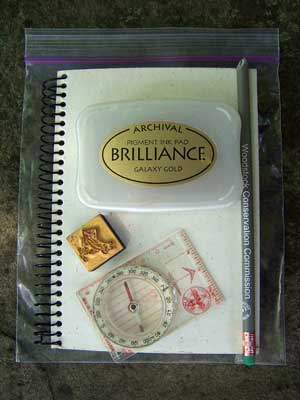
Letterboxing starter kit
Before you go, you should have a pen/pencil (to write your name in the letterbox log), a logbook (I just used the printout of the directions to the first box I tried to find, but after a few stamps it's getting pretty full), a rubber stamp and an inkpad, and a reasonable compass.  The inkpad can be any color or multicolored.  The stamp should be of something you think represents you (so probably not 'Final Notice'.  I dunno, maybe that works for some of you).  The compass is primarily used for clues that have bearings in them.  E.g., 'Look to 135', which means line up the red arrow with 'N' on your compass and look in the direction of '135' on your dial.  If you really don't know how to use a compass, try this.  Note that not all letterboxes use compass bearings as part of the clue, so a compass is not always necessary.  Also, with a small bit of local knowledge (Basically, which way is magnetic north?) and the ability to figure out where a bearing like 135 is (hint: magnetic SE), you can sometimes fake it.

You'll also want to think up a 'trail name', like Scooby and the Gang or Joffrey E. Baratheon, Super Genius, or q?87yrz.  Because, you know, 'Greg Barnes' is too pedestrian, or the North Koreans are going to track you down and start extorting classified letterbox information from you, or something.  Whatever, just go with it.  My advice:  register at a geocaching/letterboxing website and use your username as your trail name.

Speaking of websites, the easiest way to start is to go to a website.  I tried letterboxing.org first, but most of their Seattle boxes seemed stale (as in, they had not been visited recently).  Apparently all the cool Seattle kids are hanging out at AtlasQuest.com, possibly because it's run by a person in Seattle.  If you're just starting out in Seattle, I'd advise using AtlasQuest to look for letterboxes to find.  All the sites I found allow you to make a geographic search.  You can often tell just by the name of the letterbox whether it's close by; other times you have to read the description.

I started out with a box that was inside the University Heights Center, because I could easily go there over lunch, it seemed easy to find, and it had been found recently, so it was probably still there.  It was velcroed under a bench in a hallway where a bunch of kids at a private school were passing by on the way to and from recess, so this presented a bit of a problem, as you're supposed to retrieve and replace the box without anyone else seeing, lest they decide to investigate and end up taking the box home to keep.  I used the oh-so-clever "I dropped something on the floor" trick and it seemed to work fine.  I didn't employ any caution once I had the box in my hands, since I figured someone sitting down, looking at a book and making a few stamps is fairly unremarkable behavior in the U-District (the old "I'm an art student" trick).  And then I dropped something on the floor again, reattached the box, got up and left.  And then proceeded to worry for the next 10 minutes that I hadn't sealed the container properly or got enough velcro attached, and it would all come spilling out.  Still, Success!

Armed with my newfound expertise, I decided to go out after work to get a few more letterboxes and my first geocaches.

Geocaching without a GPS

From the UN-mandated Office of Geocaching

Theoretically, you need a GPS device to find geocaches, but Google Maps works pretty well in the city where there are plenty of landmarks.  Find the coordinates, plug them into Google Maps, make yourself a crude little map as to where it is (corner of 43rd and 17th, east sidewalk, lined up with the end of the fence).  As I said above, the GPS coordinates used in geocaching are not exact enough to pinpoint the exact spot, so you're going to have to search around anyway.  However, if I were in a more rural or wilderness setting, I'd insist on having a GPS-enabled device at hand while searching; they are typically not as exact as Google Maps, but it's a lot harder to pick out landmarks from a satellite view of the middle of the woods or a grassy meadow, so you'll need GPS on the spot to find the best place to start searching.

Geocaching.com calls itself the 'official' site of Geocaching, which seems a little grandiose to me.  But they are also run by people in Seattle and seem very popular, so you should start there.  They have a zipcode search and a distance search, which is good, because a citywide search of Seattle would probably yield an absurdly large number of caches.  Their search listings also (by default) highlight in green the caches that are best suited to beginners.  I'd start with these, but I'd also tackle a puzzle cache as well (this is a PuzzleHuntContest blog you know. I'll get to the Contest part later.).  A puzzle cache, as a rule, has  GPS coordinates that are bogus but close enough so that the website's geographic search gives you the right general area.  You solve a puzzle that yields the series of numbers that allow you to determine the real coordinates.  For example, the first cache I found started with a Sudoku puzzle where some of the squares were lettered A through F.  Once you solved the puzzle, you plugged the corresponding number into this formula to yield the coordinates:  
N 47° 39.AB(C+4)
W 122° 18.D(E-1)(F+5)
Puzzles can range from the simple to the extremely difficult, and come in a wide variety of formats, but almost always yield numerical answers.  Try a few out and you'll get the feel for it.

If you're heading out without a smartphone or some other way to surf the net, you're going to want to get a hardcopy of the page for the cache.  First, because you'll want to read the description if you can't easily find it, to make sure you think you're in the right place.  But also because the GPS coordinates are too crude, and you'll frequently need a hint.  Geocaching.com puts the hints in rot13 on the cache page, along with the key to deciphering them, so you'll have the hint available but basically unreadable unless you need it.  You probably don't want to print out the logs (the notes people leave on the website when they find the cache), as they can give it all away and you can end up going through reams of paper if you print out the pages for a few popular caches.

Finally, for both geocaches and letterboxes, pay attention to when the item was last found.  If it was a few days ago, you can probably assume it's still there, but if it's been over a year, you might not want to spend a lot of time looking for it.  The first time you go out, you probably only want to look for things that have been found in the last month or so, unless fruitless searching is one of your favorite things.

Eureka!


I blame David "Seattle mayoral candidate" Stern

I went searching after work, and the first stop was the geocache with the Sudoku clue.  Google Maps put the GPS coordinates in the middle of a walkway, and that seemed very unlikely, so I deciphered the hint.  After examining a few of the more prominent signposts and plants near that section of the walkway, I knew what the hint meant, but still didn't know where to look.  It took about 15 minutes to find the object the hint indicated, and it was about 40 feet from the coordinates, so there was something a bit screwy going on.  And still, I had not found the object.

As I've said before, I'm not very good at finding things hidden in plain sight; it took me 10 minutes to find a Canlis menu when I knew exactly which plane it was near in the Museum of Flight.  I walked right by the rather obvious Emerald City Search medallion last month (too busy looking at the ground).  So I considered this good training for future PuzzleHuntContests.  The cache was definitely in some plants, and I knew it was 'micro' sized (the size is listed on the geocaching.com entry for the cache; another reason to print out the webpage), so I guessed it would be a tiny plastic or metal tube.  After groping around in a few piles of wet leaves, I found what is known as a Bison Tube.  It looks a little bit like a miniature Kleen Kanteen:
Geocaching containers, not bovine anatomical parts
They come in larger sizes, by the way, and are named after the company that builds them.  Inside was a rolled up piece of paper to record your name, and nothing else.  I put my trail name and date on the next spot on the log, resealed it, then hid it back under the same wet leaves.

The next cache I found was also in a bison tube, although it had a strong magnet attached to it (so it could be stuck to a piece of metal).  My last geocache of the day was in a large Tupperware container behind a tree, on a somewhat busy road with no sidewalk.  3 for 3.

I moved on to a letterbox near the Ronald McDonald House on 40th Ave NE, where I found something interesting.  In addition to the stamp and logbook, there was a tiny film cannister labeled "P-Patch Hitchhiker Series", containing its own little rubber stamp (of a beet) and logbook.  I guessed that this was a letterbox that was supposed to 'hitchhike' from one letterbox to the next, so I took it with me.  I was right, but even if I hadn't been, it would have been simple for me to put it back the next day.  Both letterboxes and geocaches have various twists like this, and the websites have pages that explain the proper thing to do with them.  I'd say if you come across anything strange, look on the website for guidance.  If you don't have Internet access, don't do anything you can't undo.  If you think you're supposed to take something with you, and you can put it back easily if it turns out you're wrong, go ahead and take it.  But be sure to look it up when you get home and fix your error if you're wrong.  A number of items are supposed to be rehidden under certain conditions, so if you aren't prepared to rehide the item under these conditions, you should put the item back ASAP.

Summary

If you like Hunting and Puzzling, you should try geocaching and letterboxing.  They're easy to get into, and can be tried anytime and almost anywhere.  Lack of GPS should not deter you, especially in an urban setting.  Also, if you have a smartphone, it probably has good enough GPS, and there are a number of apps you can get to make the whole experience even more seamless and fun.  For example, there's an app that uses your phone's position to tell you geocaches that are nearby, and can keep track of which ones you've already found.

If you have kids, you should definitely try these activities, as a number of caches and boxes were hidden with  kids in mind, and as a rule kids like searching for 'treasure'.

If you have dreams of finding a Canlis menu or Emerald City Search medallion, searching for caches/boxes is probably the best practice you can get for the actual 'finding'.

Use the websites to communicate with your fellow searchers.  You don't need to chat with them endlessly, but they will tell you if a cache/box is missing or lost, and you should return the favor if you can't find one.

If you want the Contest aspect of a PuzzleHuntContest as well, and are in Seattle, your best bet is to use geocaching.com.  For each contest, there is the FTF (first-to-find) contest, won by the first person to find a cache.  There are other achievements to unlock as well, such as caches that you can't officially log (find) until you have logged other caches.   See for example, the Peace Sign Series.  The prizes are basically only fame in the geocaching.com community, but these are definitely contests.

Finally, if you want to design your own puzzle/hunt, placing a geocache or letterbox is probably the next step up from making a treasure hunt for your kids.

Coming up next...

PuzzleHuntContests in the next month or so.

  • Port Gamble Rogaine - May 12, Port Gamble.  I think it's too late to register now.  Look at that weather forecast, and weep at your lack of planning.
  • BEAST race #2 - May 17, Lynnwood.  Adventure race in Lynnwood.  Hint:  If you go down to the Puget Sound, you're gonna have to make your way up eventually.  Hint 2:  You're gonna have to go down to the Sound.
  • Dumpster Champ - May 19.  Dumpster diving and bike racing.  Two great tastes that go great together.
  • Seattle Challenge - May 19.  The first of the 'Amazing Race' style events of the year.  The prize:  Real Cash Moniez!
  • Battle for Seattle - May 19.   Photo Scavenger Hunt, UW Students only.  With only 2 weeks of classes left, this is a prime opportunity to avoid studying.
  • Evening Orienteering - Wednesday, May 23, Robinswood Park, Bellevue.  Orienteering + free food.  The only thing that will stop me attending this is another presidential visit.
  • Gig Harbor Street Scramble - May 26, free.  Once you've made it to Gig Harbor on the Saturday morning of a 3-day weekend, you're legally obligated to go camping somewhere.  Just warning you.
  • Hood Hunt Moses Lake - June 2.  Speaking of camping...
  • Long O - June 2, Moses Lake.  Sand Dunes!  Bring extra socks.
  • Kid and Goat O - June 3, Fishtrap Lake.  This area (channeled scablands) is amazing, and you should go there.
  • First Thursday Adventure Run - June 7, Green Lake.  Seriously, all you have to do is walk a block and you're entered to win thousands of dollars in prizes.  Why aren't you doing this?
  • Evening Orienteering - Wednesday, June 13, Kelsey Creek Park, Bellevue.  This may have been moved to the 20th.